Showing posts with label Artwork. Show all posts

Tuesday, January 20, 2026

Cup of Coffee: Moonlight Graham


Moonlight Graham

  • Moonlight Graham is the epitome of Cup of Coffee Players. His brief baseball career consisted of two innings only in the field, he never got the opportunity to bat.
  • However those 2 innings were celebrated in fiction and on screen though the WP Kinsella novel "Shoeless Joe" and the film adaptation "Field of Dreams"
  • The canvas for this Cup is the 1908-09 Rose Company Postcards (PC760). A set that Archie "Moonlight" Graham appeared in as a minor leaguer
  • The Caduceus symbol is present to represent Graham's career as a Physician.
  • Moon appears top right for Moonlight
  • A. Graham for Archibald
  • Figure in the bottom left is to show that Graham only played in the field.


Sources and Links

Monday, April 18, 2022

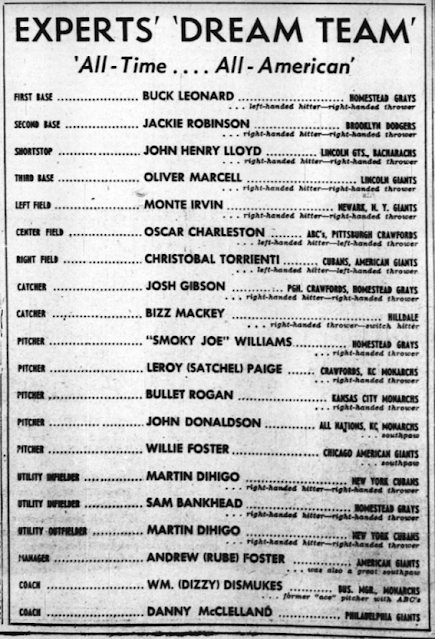
1952 Pittsburgh Courier All-Time All-America Team.

This month marks the 70th anniversary of the Pittsburgh Courier naming an All-Time All-Star team.

The Courier was an African American Weekly with a lot of baseball coverage.  In 1952 the paper surveyed 31 of the top baseball men in the country 

On April 19th 1952 they published the results: 


As part of our latest ArtCard Project we have taken the 1952 Courier Selections and created cards for several of the players using the 1976 Topps All-Star subset. 

Battery

First we have the Battery. LHP John Donaldson was a showman who created a blueprint of how to make money outside of segregated MLB - this same idea would be adopted by Satchel Paige. To show this relationship we added a nod to Paige in the form of a US postage stamp behind Donaldson. Smoke Joe Williams and Biz Mackey who played for the Philadelphia area Hilldale Daisies round out the battery selections. 

Infield

The Infield is let by Jackie Robinson who we show here "Breaking Barriers" of the card/frame. We don't know a lot about Oliver Marcelle but his nickname was ghost, an image we added above his right shoulder. Above his left shoulder we have his son Ziggy Marcell who played in the 1930s era Negro Leagues. 

Outfield 

We conclude with the Outfield. Both Cristobal Torriente and Martin Dihigo are natives of Cuba and we have added the countries flag for each. There flairs on Monte Irvin's card represent the day that he went out to purchase a saxophone but instead came home with a baseball glove.

If you want to delve more into the Pittsburgh Courier selections here is the full page from 1952. You will need to click on the image and expand it to read the details.


Sources and Links
Pittsburgh Courier 1952 April 19 

Monday, October 5, 2020

ANNIVERSARY - Jim Palmer: 1971 Topps #197 ALCS Game 3

October 5th marks the 50th anniversary of the Orioles clinching American League pennant sweeping the  Minnesota Twins in 3 games. 

1971 Topps #197 (image swiped from comc.com)

I would normally dissetc this card and discuss the game box for the Orioles 6-1 victory, but last week I broke my arm and typing is a pain with one hand. 

The busted humerus did not stop me from finishing up my O's Orange version of this card.

1971T Jim Palmer Mows em Down

i changed the classic 1971T Black Border to the Orioles other team color,  added  Palmer's dominating pitching line, and tagged the game date.  Other modifications include making the baseball prominent and emphasizing Palmer's #22.

Box

ok I peeked at the box and Palmer's strikeout victims included future HoFs Harmon Killebrew and Rod Carew. Other notables were Tony Oliva and Phillies World Series manager Charlie Manuel. 

sources and links

Jim Palmer HoF index

Phungo Originals

baseball-ref


Thursday, September 3, 2020

1974 Topps #80 Tom Seaver (1944-2020)

I learned a lot about Tom Seaver while researching “The Andy Warhol Triple Play”. My focus was Warhol but I learned a lot about his subjects, one of which was Tom Seaver.

The more you learn about Seaver the more interesting he becomes. He was more than a ballplayer, He was a devoted family man, a vintner, and a connoisseur of the arts.

One of his many interests popped up recently when I saw the cartoon on the back of Tom Seaver’s 1974 Topps card. 

1974 Topps #80 Tom Seaver (b-side)

Tom Enjoys Playing Bridge. Mildly interesting… Then last night while re-reading my notes from the Warhol Project I came across an enjoyable blog posting written by Phillip Richter, a schoolmate of Tom and Nancy’s daughter Sarah. An excerpt from the column read:

While walking and talking and tending to the vineyards, Tom made the comment that pitching is like playing bridge. To be a really successful pitcher you have to get inside the mind of the batter. Is he having a good day? Will he wait for a fat pitch or just aggressively strike at anything served to him? What are his goals? How consistent a player is he? Your goal as a pitcher is to control the outcome. Tom said that it was his job to control where the ball was going to go should the batter connect with the ball and make a hit.  I know next to nothing about baseball but Tom’s complex and astute thesis was logical and so well articulated. It made all the sense in the world. I would never have seen parallels between the game of bridge and the art of throwing a baseball at high speed. Tom knows that I’m not a crazed baseball fanatic but I have always had huge admiration and respect for his many incredible accomplishments. Back in the day I was around for a lot of his career highlights–like when he got his 300th win in 1985. 

Tom Seaver just doesn’t play bridge, he plays bridge the way he pitches or pitches the way he plays cards. The article was written in 2016, Seaver would have been 71 years of age – 30 years removed from his final pitch, yet here he is making parallels between two games he loves. 

1974 Topps

1974 Topps #80 Tom Seaver

I have always loved this card, great action shot of an absolute legend - good use of the landscape format in the mainly portrait style 1974T set. 

The card re-drew my attention earlier this summer as part of a Project2020 inspired activity spearheaded by @_gritz_ of Project 62.  Gritz posted a randomish page of 9 noteworthy trading cards. Similar to Project2020 the assignment to the world of amateur artists was to redesign the card – Project2020 for the common folks.

One of the cards posted was the 1974T Seaver. 1974 has the best -toons and I had to flip the card over. That is where I spotted the comic. Once I saw it I knew that was the route I was going:

 Phungo Original: 1974T Tom Seaver

In creating my own Tom Seaver card I kept the 1974T design – in a simplified format. The original comic is more portrait – I have changed it to Landscape format which necessitated moving the copy. I added a touch of color to the lines – keeping the Mets 1974T flavors. My biggest remaining modification was identifying the card being pitched by Seaver as the Ace of Diamonds – which he truly is.   

It was a fun card to do and I think of Tom Seaver as a happy individual who was able to pass that joy on to those around him, I hope this Phungo Original captures that vibe.

In Memoriam

Links to other folks that have Tom Seaver Memorial Postings:

1960s Baseball (1968T)

Cards that Never Were (1968T Seaver LHP w/ Bob Gibson LHP)

Starting Nine (41 Scans for #41)

Sources and Links

Andy Warhol: Tom Seaver

Phungo Tom Seaver HOF Index

Turtle Garage

@_Gritz_

Project 62


Tuesday, August 25, 2020

Ted "Double Duty" Radcliffe: T201 Mecca Double Folder

Recently my sketches have been focused on the players of the Negro Leagues. Today we featured Ted "Double Duty" Radcliffe who got his nickname from pitching one end of a double header followed by catching the other.  

 I was interested in a way to capture this idea on a baseball card. 

1911 T201 Mecca Double Folder Ted "Double Duty" Radcliffe

The T201 Double Folder was the perfect solution. Unfolded/Open features Radcliffe pitching, while the folder version shows him catching. 

While the video is fun, I kind of think it is easier to see the images in stills.

1911 T201 Mecca Double Folder Ted "Double Duty" Radcliffe (pitching)

 For the pitching image I put in Radcliffe in pinstripes and on a basically clear field.


1911 T201 Mecca Double Folder Ted "Double Duty" Radcliffe (catching)

As a catcher I made Radcliffe a catcher for the Birmingham Black Barons. whom he played for from 1942-46. I went with an industrial background here - typical of many Negro League stadium. 

Time

The card is a bit of an anachronism. Radcliffe's career spanned 1928-50 so 1911 predates that period a bit, but the double folder was to good an idea to pass up.

Sources and Links

Phungo Originals

Phungo Negro Leagues

Seamheads

Negro League Baseball eMuseum 

Cardboard Connection

Sunday, August 9, 2020

1974 Topps #47 Dick Ruthven

Dick Ruthven was drafted three times: 1969 (20th round Orioles) 1972 (Twins 1st rd / 8th pick) and finally by the Phillies (1973 Winter #1 overall)

1974 Topps #47 Dick Ruthven

As a highly touted prospect Dick Ruthven made his pro debut at the Major League level. This means no multiplayer RC - Ruthven's first card is the above 1974T and it's a solo. 

It was not a straight line for Ruthven and the Phillies to the World Series. There were a series of trades involving Ruthven which are worthy of their own discussion but the important result was that Ruthven ended up in the rotation for the 1980 Phillies. 

1980 Phillies 
Yes Dick Ruthven was an important member of the 1980 Phillies pitching staff - he was 2nd on the staff (behind Steve Carlton of course) in Wins, Starts, Complete Games, and Innings, however..... I will always remember him for a relief appearance.

Game 5 of the 1980 NLCS

The deciding game of the series saw Phillies closer Tug McGraw blow a save. Dallas Green had already gone through four other pitchers. The staff was shot when Dick Ruthven was called into the 9th inning of the Winner Take All game.  And what does Ruthven do in his only relief appearance of 1980?

Six up Six Down, Phillies Win 8-7.

Ruthven did that on 18 pitches - 2 innings on 18 pitches, including a six pitch inning.

Phungo Original

Phungo Original :1974T Dick Ruthven

I chose this card for our 1980 WSC Phillies sketch for two reasons. 1) it is significant to Dick Ruthven as it is his RC 2) We are clearly focuses on his NLCS Game 5 relief appearance and this shot clearly shows the bullpen in the background. 
 
To further illustrate Ruthven's 1980 NLCS contributions we have made a few minor modifications. The first is adding "RELIEF" to Ruthven's "PITCHER" position. The other change is a fun one, we have added a Bullpen Cart to the image.  The cart is also a nod to a different 1974T card - of a very prominent Phillies Player, Mike Schmidt

Dick Ruthven Index
1975 Topps (2008 Game 5 prep)
1975 Topps Mini (2010 Philly Show Swag: mini w/ 1959T Robin Roberts)

Sources and links
1980 Phillies
baseball-ref

Monday, May 18, 2020

Phyllis George (1949-2020) the Woman who came between Pete Rose and Andy Warhol


Phyllis George and Bill Kurtis (1985 Jan 18/ Getty Images)

While researching "The Andy Warhol Triple Play" for SABR48 in Pittsburgh one of the fun tidbits that I found out that got dropped from the final presentation involved 1971 Miss America Phyllis George.
Andy Warhol "Pete Rose" Test Print

Carl Solway had conceived the ides of having Andy Warhol painting a portrait of Pete Rose in April of 1985. To produce the painting in a timely (thus "pop") manner meant that for Pete Rose to sit for Warhol the meeting would need to happen during the baseball season.

The Reds only traveled to New York once during the remainder of the 1985 Season. That was a week day series from July 22 through 24th.

1985 Cincinnati Red Schedule (RedsCardCollector 2015 Oct 06)

Unfortunately for Solway and Warhol, Rose had a lot going on. In addition to the normal rigors of playing AND managing for the Reds Pete Rose also maintained a very busy press schedule.

Rather than sitting with Warhol while in New York Rose elected to spend his free morning on the CBS Morning News with Phyllis George.  And we know about it because Rose covered in his journal of the 1985 season "Countdown to Cobb" Co-Written with Philadelphia based author Hal Bodley.

 Countdown to Cobb - Rose/Bodley

The interesting passage above is the 2nd paragraph (click to enlarge) where Rose mentions he already was familiar with Phyllis from guesting on "NFL Today"

"I took the Greek’s (Jimmy the Greek) spot and talked about each of the NFL games."

Certainly not a shock, but it is a bit comical to know that Pete Rose was handicapping games on NFL Today.

So that is the story of how Phyllis George came between Pete Rose and Andy Warhol.

Getty Images
Getty Images / SI - Chuck Solomon (1985 JUL 24)

Amazingly Getty Images has photos of Rose playing in the 3rd game of the Red Mets Series.  

Andy Warhol
Getty also has Photos of Warhol during this time frame.
Andy Warhol and Debbie Harry demonstrate the Amiga Computer (Allan Tannenbaum 1985 Jul 23)


Warhol also has his own journal for 1985, The "Warhol Diaries" confirms that he and Debbie Harry were doing a promotion for Commodore Computers at Lincoln Center that day.

The Diaries also states Warhol thought his "drawing" of Harry was "terrible".

Scheduling Conflicts
There you have it. Rose was in NYC for 3 days. Monday Rose elected to appear on CBS - previewing his upcoming book. Tuesday Warhol was busy at Lincoln center and Wednesday was a day game.

That was the one chance for the two icons to meet, Warhol ended up doing the painting from photographs. You can read more about that here.

Sources and Links
Phungo Andy Warhol - Pete Rose Index
imdb
Countdown to Cobb - Pete Rose / Hal Bodley
Carl Solway
Baseball-ref
Getty / CBS (1985 Jan 18
The Andy Warhol Diaries

Wednesday, January 8, 2020

1980 World Champions: Larry Bowa 1971T #233

We have turned over into a new year (and decade) so we can officially celebrate the 40th anniversary of the 1980 Phillies.

1971 Topps #233 Larry Bowa (b-side)

This is not Larry Bowa's rookie card, he shared 1970T #539 with fellow middle infielder Denny Doyle.

However this is Bowa's first solo card and it is a fine card. To start with we have one of the most iconic designs in the Topps canon, 1971. Secondly the photo captures Bowa in a defensive posture, which was his most dominant skill during a long career. Finally this card is part of one of Team Phungo's favorite collections: All-Star Rookie Cards.

The cup was awarded to Larry Bowa for his 1970 campaign that saw him finish 3rd in the Rookie Of the Year voting (Carl Morton, Bernie Carbo).

I would also like to give a shout out to Paterson New Jersey's Johnny Briggs who appears in the background of this shot. Briggs spent the second half of the 1960s on the Phillies roster but was only teammates with Larry Bowa for one year as he was traded early in 1971 season.

1971 Topps #233 Larry Bowa (b-side)

Lots of fodder on the back of Larry Bowa's 1971T card. TOPPS goes all selfie and mentions the award they have given to Bowa. The most noteworthy portion of the text is Topps use of the term '"On-Base" average' which I imagine is one of the earliest on card uses of the term.

Unfortunately Topps use of the word "fine" to describe Bowa's OBA is questionable. At .277 he ranked 53rd among the 56 NL players who qualified. The League Average was .329, Bowa's 21 walks ranked 110th.

The final sentence in the bio refers to Paul Bowa, his baseball-ref page can be found here

Not sure where the front image was taken, could be spring training or possibly Shea stadium, but this back photo sure looks like the Vet - Even in b&w.

1970 RoY voting
As mentioned above Bowa finished 3rd in the NL Rookie of the Year voting:

Carl Morton or Bernie Carbo deserved to be 1-2 by both 1970 standards and modern analytics. To be honest I am surprised the BBWAA went with Morton (18-11, 3.60 ERA 154K) over Carbo (.310, 21 HR).

Among the 5 players receiving votes he was clearly the least deserving. However, other than Cedeno he is probably the player to have the most career success. He is also the only player among the lot to win a World Series.

Phungo Originals

This is one of the cards that made the cut for the Phungo Sketch Challenge

Phungo Original 1971T Larry Bowa

I swapped out the Rookie Cup for a World Series Trophy and went with a simplified background. I think Larry looks more like John Vukovich - oh well, my art career is a Work In Progress - perhaps I can say I have a "fine On-Base Average"

Larry Bowa Index
1972 Topps #520 (2008 NLCS)
1975 Topps #420 (1976 All-Star Team +40)
1975 Topps #420 (Larry Bowa Bobblehead night 2015)
1976 ASG Program (1976 ASG +40)
1981 Fleer #645 (1980 Phillies Reunion/Card Show w/ Pete Rose & Mike Schmidt)
1981 Fleer #645 (1980 Phillies +30)
1984 Topps #704 (1983 NL Champs w/ Joe Morgan & Cedeno)

Peanut Gallery (Other columns on this card)
Topps Baseball 1971 (Night Owl Cards)

Sources and Links
1980 World Champion Philadelphia Phillies
1971 Topps All-Star Rookies
Phungo Artwork
1971 Topps Blog (Night Owl Cards)
baseball-ref
SABR Bio Larry Bowa Rich D'Ambrosio 
SABR Bio Johnny Briggs (John Saccoman) 

Thursday, September 26, 2019

Happy Birthday Mike Schmidt: 1977 Topps #140

On September 27th Mike Schmidt will celebrate his 70th birthday. To mark the occasion we are examining a card that was issued back when Schmidt was 27 just on the cusp of hitting his prime.

1977 Topps #140 Mike Schmidt

In 1976 the Phillies wore a Bicentennial/All-Star Game patch on their left shoulders. The 1977T card which displays the patch most prominently is Mike Schmidt's.

That is probably my favorite aspect of the card. I have two other photo observations:

1) I believe this is Shea Stadium which is the setting for several Phillies cards in the era.

2) Schmidt appears to be swinging a Rawlings bat. Adirondack/Rawlings bats from the middle 70s carried a ring on the bat handle in the team color - seen in red here.

However, during a Louisville Slugger tour I took a few years ago I found out something interesting:

Louisville Slugger Museum

Above we have four Louisvlle Slugger Bats. Schmidt's lumber is the 3rd one from the top, notice the Red ring. Schmidt had an exclusive contract with Rawlings, however at times he felt the need to change bats. To hide the switch, Schmidt disguised the Louisville Slugger bat by creating his own red ring using tape. More detail on this can be found at the PSA Card site.

The four bats top to Bottom are Cal Ripken, Eddie Murray (HR #501, last as an Oriole), Schmidt and George Brett (note the Pine Tar).

 Flip
1977 Topps #140 Mike Schmidt (b-side)

This is the first card issued following Schmidt's Four Home Run game on April 17 1976 and the text leads of with that fun fact. The blurb closes mentioning that Schmidt had 11 Homers in April which is a record - not sure if this is for any month or specific to April. Regardless both records have been eclipsed since 1976. Sammy Sosa holds the MLB Record for HR in a month with 20 (June 1998), While the April Record of 14 is shared by Albert Pujols (2006) and A-Rod (2007).

Talkin Toons
Always good to see a cartoon on the back of the card. The subject of today's comic is Yankees Slugger Hank Bauer and his17 game Wolrd Series hitting streak( 1956 OCT 3 - 1958 OCT 4).  At the time this card was released Bauer had held the record for 18 years. Here we are almost 42 years later and he still holds the record. the 2018 World Series marked the 60th Anniversary of the record.

Bauer's 17 game hitting streak is also the record for consecutive postseason games as well. He shares the record with Derek Jeter (1998-1999) and Manny Ramirez (2003-2004).  The Astros George Springer has an active streak of 14 games

Bauer Toons
A couple of Hank Bauer own cards have comics that feature the record including 1960 and 1961.  My favorite is a manager card from 1969.

1969 Topps #124 Hank Bauer (b-side / baseball card datbase)

Rather than featuring a lengthy text bio the Manager cards from 1969 featured a full size cartoon that include a nice profile sketch.

Artsy
Speaking of sketches and bringing this back to our original subject, I created my own version of the 1977T Schmidt card.

1977T Mike Schmidt (Phungo Original)

Drawing 1997 Topps doesn't present any unusual challenges. The Team names are italicized which is a minor hassle. I like the drop shadow on the pennant.

I elected to leave the team logo and number off the uni, which are largely covered in the original - unfortunately this leaves a lot of blue space on the drawing and elongates Schmidt's Torso.

1980 Phillies
I am including this post as part of our 1980 Phillies Series. I hope to return to Schmidt again next year as he is not only one of the  most significant members of that particular team but also the franchise history.

Sources and Links
Mike Schmidt HoF Index
1980 Phillies World Champs Index
Phungo Artwork Index
Baseball Almanac
PSA Card
baseball card database
mlb.com / Astros 
Baseball-Ref

Wednesday, September 4, 2019

1973 Topps #322 Garry Maddox (rc)

Little late on this one but Garry Maddox turned 70 over the Labor day weekend. To celebrate we are posting a column on his rookie card.

1973 Topps #322 Garry Maddox (rc, image from Baseball Card Database)

Over here at Phungo Headquarters we think of Garry Maddox as a lifetime Phillies player, but as can be seen above early in his career he spent a couple of years with the Giants. Nice to see Maddox get a solo card here as many rookies from this era were awarded shared cards.

However there is a sloppy Topps element to this card as well.  Garry Maddox was a member the 1972 All-Star Rookie team, unfortunately Topps failed to put the trophy icon on his card.

As part of the Team Phungo Art initiative we have decided to correct this error, and while we were being creative we decided to modify a few other things about the card.

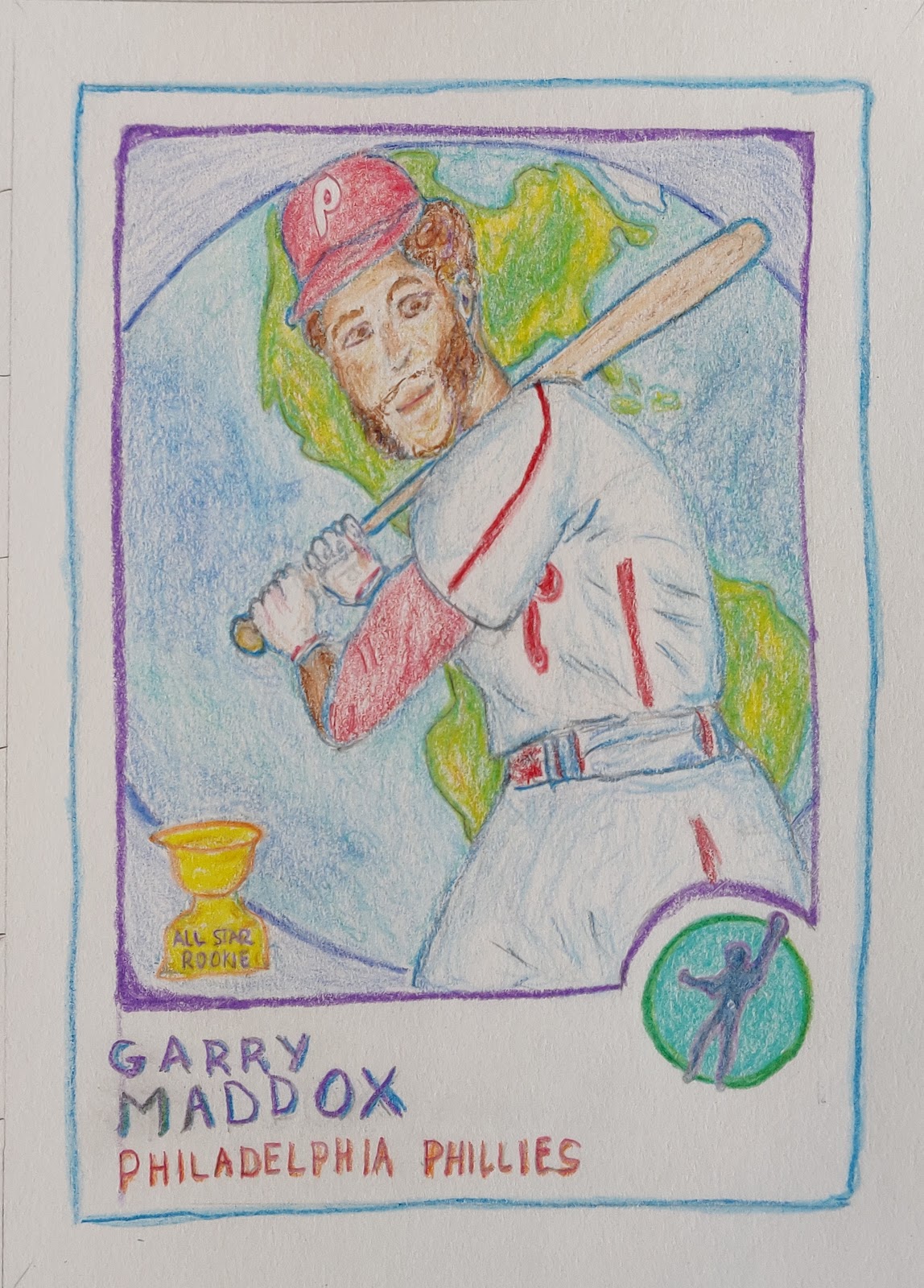
Phungo Original 1973T  Garry Maddox

Yes since I was going to the trouble of drawing a new card of Garry Maddox with the Rookie Cup, I figure why not make him a Phillie. I tried to get Maddox face and figure to match the card photo, but with the background I got a little crazy and put in a globe.

The idea was inspired by the quote "Two-thirds of the Earth is covered by water, the other one-third by Garry Maddox." which is often attributed to Ralph Kiner.

So yes in one drawing I made the Topps card my own by 1) Changing the team 2) Adding the missing Rookie Cup and 3) Including a globe in the background to honor Maddox defensive notoriety.

1980 Phillies

The other reason I did the Maddox artwork was because I thought that this was a fun card on the Maddox player collection checker and I wanted to make the card part of our 1980 Phillies retrospective.

My goal is to put together a dozen or so columns on the 1980 Phils, but since I don't post as often I a starting a little early. A few months ago I wrote up Del Unser which I plan on adding to the collection.

For an index of all 1980 Phillies related postings click here. Not much there yet, but hopefully there will be by this time next year.

Whiz Kids
We also profiled Maddox as part of our series on the 1983 Phillies. That posting will be used as our Garry Maddox Index

Sources and Links
Garry Maddox Index
1973 Topps All-Star Rookie Cards Index
1980 World Champion Phillies Index
Baseball-Ref Bullpen
Baseball Card Database
Baseball Almanac

Wednesday, June 26, 2019

1967 Topps #165 Cleon Jones

I often find the "Where are They Now" features on retired ballplayer fascinated. Particularly those that are accomplished off the field.

Recently I saw a a news item on 1960s-1970s era Mets outfielder Cleon Jones.

1967 Topps #165 Cleon Jones

Jones has returned to the community where he was raised, Africatown Alabama which is near Mobile. He is 76 now and is busy helping out townspeople and elderly folks fixing and painting their homes. Africatown is an historic town in the area which is attempting to build a museum to honor the communities past. To read about the towns history, I strongly recommend you read this Alabama Newscenter article to find out about Africatown and Cleon Jones' efforts.


1967 Topps
Seeing the story about Cleon Jones also gives us a chance to add a column to our All-Star Rookie Cup Series. Unless team Phungo returns to serious blogging the Series will remain unfinished, but I do think it is within the realm of possibility to get up a Rookie Cup from each year and all the Phillies.

For his 1966 Cleon Jones received a single Rookie of the Year vote, good enough to place him 4th in the voting which was won by Reds Infielder Tommy Helms. Jones played 13 years which is wear several of his 1966 Topps Rookie All-Stars mates fall. The leader for tenure appears to be Woodie Fryman (LHP 18 years), while George Scott (1B) led the crew in WAR (36.5, Jones = 18.5). 

1967 Topps #165 Cleon Jones (b-side)

No pressure here, just that the back of Cleon Jones' first solo card mentions Hank Aaron, Billy Williams and Willie McCovey (featured on the very first Topps All-Star Rookie Cup card)

Sketchy
One of the many reason blog output has been slow is I have diverted my hobby time to artwork - mainly sketching baseball cards. Cleon Jones off the field charity inspired me to create a 5x7 based off of his 1967T card coupled with his efforts in Africatown.

1967T Cleon Jones (Phungo Original 5x7 in 2019 06 24)

Chief among my customizations is changing the bat to a paint roller. I also added a different trophy, changed the Mets team designation to Africatown and gave Cleon a background of a refurbished home rather than Shea Stadium.

Sources and Links
1967 Topps Rookie Cup Index (1966 Winners)
Phungo Sketch Index
Alabama NewsCenter
Baseballl-ref BR-Bullpen

Sunday, February 3, 2019

Radcliffe Bailey: Mound Magician

If you do take in the SuperBowl or promotional programming today you may hear the name Radcliffe Bailey. No he is not a player or coach, he is an Atlanta based artists who has a marquee work in the Mercedes-Benz stadium which is hosting tonight's game.

Bailey has done a few baseball themed works including a piece titled "Mound Magician":  

Mound Magician: Radcliffe Bailey (Nelson-Atkins art museum)

The canvas of the collage is shaped like a baseball field with a #25 in a star at the center which represents Satchel Paige. The number was worn by the future Hall of Famer while a member of the Kansas City Monarchs. Similarly Josh Gibson #20 his shown at home plate. There are a number of other baseball references throughout the picture included a black & white photo in the second base area.

Conduit of Contact: Radcliffe Bailey Atlanta.Net

Radcliffe Bailey's work at Mercedes-Benz stadium is an 84 foot mixed-media behemoth which chronicles the journey of football at Atlanta Historically Black Colleges.  However that is just part of the artwork which also tells the much broader story of the black experience and African-American history.

Sources and Links
Nelson-Atkins Museum of Art
Atlanta Magazine
Atlanta.Net

Thursday, January 31, 2019

1956 Topps Jack Robinson


Notice in the title I have referred the pioneering civil rights leader as Jack Robinson not “Jackie”. That is because in interviews his wife Rachel (Still living at 96!) has mentioned that is what she always called Jack.

I have also chose to use the name Jack Robinson on my latest phungo original cardboard creation


1956 Topps Jack Robinson (phungo variation)

So far I have made about three dozen colored pencil drawings and this is one of my favorites. I think to myself the drawings may not look like who I want them to, but it does sort of look like a person.

While this work is inspired by Robinson’s 1956 Topps card it is far from a replica. First off, as mentioned above, is the name modification. The next major difference is that I changed the play at the plate – I chose the iconic image from Robinson’s steal of home versus the Yankees in game 1 of the 1955 World Series. The play is filled out in color while the portrait side of the card is done with an abstract black & white background. This is a nod to the crossing of the color line – further symbolized by the foul line in the action shot.  This barrier is also illustrated by the staccato lines behind Jack’s headshot which echoes a fence – the line unbroken prior to Jackie Robinson entering major league baseball. 

I added a 42 to Jackie’s uniform. This is not historically accurate for Dodgers jerseys of the era, but I felt the number has become so much a symbol of our cultural memory it belonged in the illustration.


1956 Topps #30 Jackie Robinson

For comparison we present here the original 1956 Jackie Robinson card featuring the full background and original action shot.

Gummy Arts put together this more faithful rendition of the card.


1956 Topps #30 Jackie Robinson (Gummy Arts edition)

One of the other Robinson artworks I spotted today was done by Tim Carroll 


Carroll also uses the B/W vs color to mark the breaking of the color barrier. His works are mosaics created by using discarded baseball cards to create a new image. 

Sources and Links
Imdb

Jackie Robinson 1956 Topps, Dodgers, Artwork


Monday, July 23, 2018

Pete Rose (1985) Andy Warhol: The Original Gordon Baer Photograph

One of the Pop Art techniques that Andy Warhol pioneered was the appropriation of photographs. He starting using the PhotoSilkscreen process in 1962 - this allowed him to 1) enlarge a photograph and 2) project the image onto a canvas multiple times. His first use of this method can be seen in the painting Baseball.

Andy would use the PhotoSilkscreen once again when he produced his portrait of Pete Rose in 1985.

Originally it was hoped that Pete Rose would visit Andy Warhol[s studio for his portrait, alas the busy schedules of the two men made coordinating the sitting impossible.

Warhol ended up doing the Rose portrait based off of photographs, The principal photograph used was one by Cincinnati based photographer Gordon Baer

Pete Rose: Gordon Baer Photo (left) and Andy Warhol Portrait Detail (right)

This is the only copy of the Baer photo that I could get. I assume the one that Warhol used was in color, however most of Gordon Baer's photography was in B&W.

Baseball historians have noted two interesting issues with the Warhol painting. In 1985 Pete Rose used a Black Mizuno brand bat, in the Warhol painting the bat has a clear stain. Notice that the bat in the Baer photograph also has a natural stain.

The second complaint is that the switch-hitting Rose was portrayed batting right-handed by Andy Warhol. "Only" 1171 of Pete Rose's 4256 career hits (28%) came from the right hand side. By 1985 the percentage of Rose's RH hits dropped below 16% (17/107). Once again since Andy was reproducing a photo with Rose batting right-handed he ended up with a RH painting.

Pete Rose on Hitting
During the 1985 season there was a flurry of activity around Pete Rose's pursuit of Ty Cobb's hit record. One of these projects was "Pete Rose on Hitting: How to Hit Better than Anybody" which Pete co-wrote with Peter Golenbock. The photography for the book was done by Gordon Baer and includes the picture that Andy Warhol used for the Rose portrait.

Unfortunately this picture in "Pete Rose on Hitting" brings up a third problem with Warhol's portrait:

Pete Rose on Hitting: How to Hit Better than Anybody

Yes the photo used by Andy is a associated with Pete Rose's entry dedicated to bunting.

Gordon Baer
Gordon Baer's work dates back to the 1960s including a stint as a military photographer in Korea. During the 1980s his NYC exhibition titled "The Battle Comes Home" featured photographs of Viet Nam veterans - many of whom likely suffered from the then unnamed Post Traumatic Stress Disorder (PTSD). You can read about his a 2012 retrospective of Baer's work here.

Sources and Links
Andy Warhol Pete Rose Index
Andy Warhol Index
Pete Rose IndexCincinnati Art Museum
Pete Rose on Hitting - Peter Golenbock Pete Rose
AEQAI - A Look Back at a Life in Pictures: Photographs by Gordon Baer 2012 OCT 12
Capturing the Essence City Beat - Jane Durrell
Warhol's Baseball Art is a Hit at CAM City Beat - Steve Rosen 2015 APR 7
Baseball-ref

Monday, July 16, 2018

Tom Seaver (1977) Andy Warhol: 1977 July 20 - A Tale of Two Caps

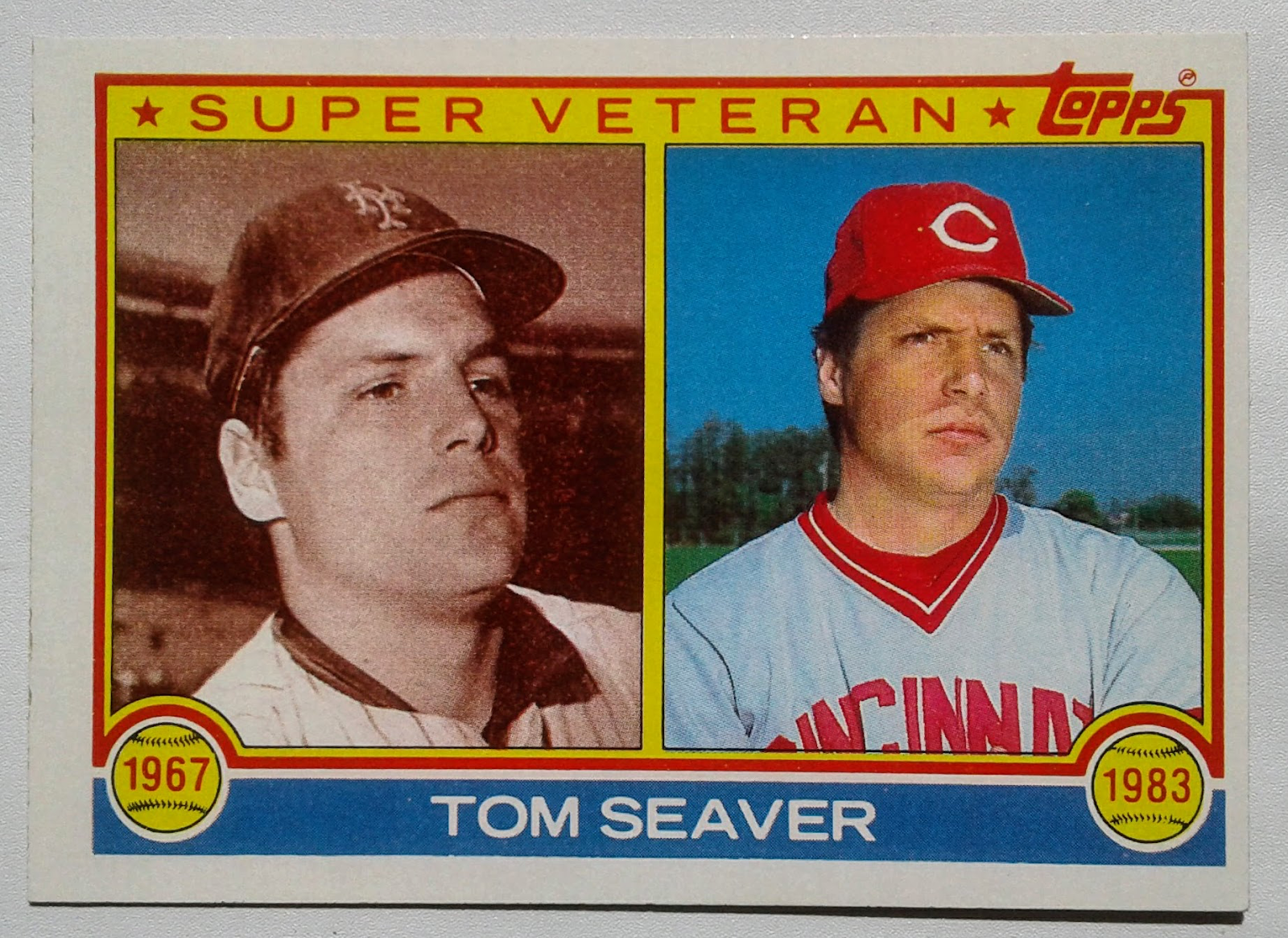
1983 Topps #581 Super Veteran Tom Seaver

One of the reasons Richard Weisman picked Tom Seaver for Andy Warhol's Athlete's Series is that he was the ballplayers proximity to New York would make it easy to set up a portrait sitting at the artists studio in Manhattan.

Unfortunately things happen...


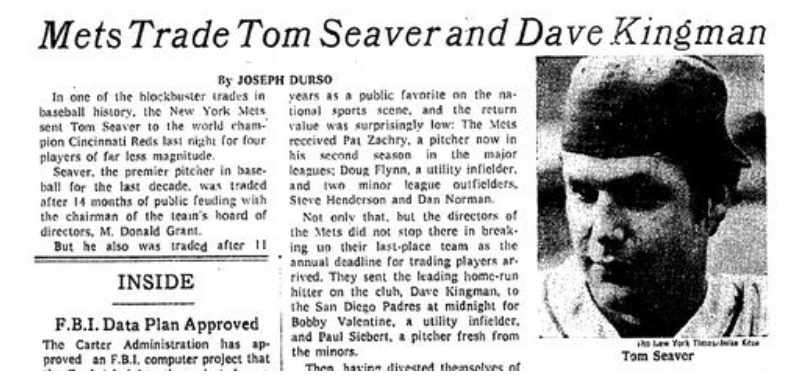
NYT 1977 Jun 16

On June 15th of 1977 the Mets traded Tom Seaver to the Cincinnati Reds. I am not going to go into the ugly details that led up to the trade, I will only note that the Mets-Seaver relationship did not end on friendly terms.

As we noted earlier despite the trade Seaver was able to sit for the Warhol portrait when he retuned to New York for the All-Star Game. Within the Warhol Diaries there is an interesting anecdote about the Seaver and the Mets.

The first passage discusses how much Andy Warhol appreciated Seaver and Athletes in general, The 2nd and 3rd portion get to our "Tale of Two Caps"


This is a mere month after Seaver was traded by the Mets and he was still angry with the club. What Andy relates here...

"He hates the Mets now. He'd just bought a new house in Connecticut and everything when they traded him"

Is so brutally honest. It isn't really new information. Anyone familiar with the Mets or Seaver knows the details, but it is interesting seeing it from a non-baseball perspective.

The wound was still raw for Seaver and clearly his feelings towards the Mets left an impression on Warhol. It is the kind of thing a perceptive artist who only sat with his subject for an hour may find out that a reporter with a microphone may not.  

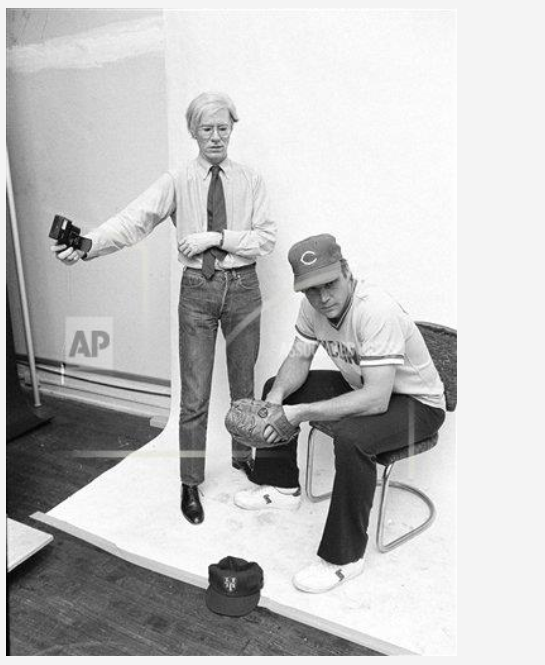
Thanks to photographer Rene Perez we have some interesting documentation of "A Tale of Two Caps"


AP Image / Rene Perez

We have Andy photographing Tom wearing a Reds cap, but then we can look down and THERE IT IS! The Mets Cap that Tom Seaver refused to wear for this portrait sitting.

Fortunately for Tom Seaver and the Mets, they have resolved their differences. Tom Seaver's #41 is retired by the club and can be seen on the walls at Citifield

To read more about the Tom Seaver Portrait sitting click here.

Sources and Links
Andy Warhol Tom Seaver Index
Andy Warhol Index
The Warhol Diaries
1977 JUL 20: Tom Seaver Portrait Sitting  with Andy Warhol
New York Times
Rene Perez
AP Images

Tuesday, July 10, 2018

Tom Seaver (1977) Andy Warhol: 1977 July 20 - The Portrait Sitting

The commission of Andy Warhol's Athletes Series was funded by investment banker and art collector Richard Weisman.  Since Warhol was unfamiliar with figures in the sports world if fell on Richard Weisman to pick the subjects. The first two athletes he picked were New York Rangers Hockey player Rod Gilbert and Tom Seaver.

Part of the reason the two were chosen was proximity, both athletes played for New York teams which simplified getting them to Andy Warhol's studio which was also located in the city.

Unfortunately for Weisman on June 15th 1977 the New York Mets traded Tom Seaver to the New York Mets.

Seaver's first return to New York was just under a month later for the All-Star Game at Yankee stadium on July 19th. A day later Tom Seaver was at Andy Warhol's factory to sit for his Athletes Portrait.


AP Images / Rene Perez

I love this photo. Two of New York's most iconic figures from the mid-1970s. They have the tools of their trade in hand, Andy with his camera, Tom with his glove. In the quaint pre-MegaMerchandising days of 1977 the players likely didn't wear special uniforms for special games so I am thinking there is a good chance that the Travel Jersey worn by Seaver here may be the same one he wore during the previous nights All-Star game.

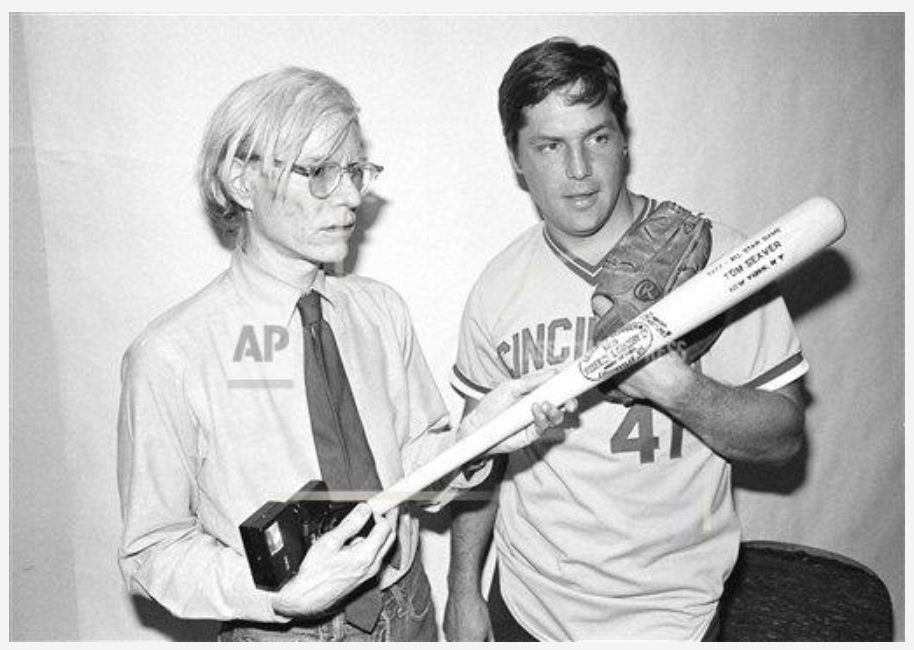
Thanks to Rene Perez, who is now a fine art photographer, we have several great photos of the Seaver portrait sitting. The pictures are a nice document of how Andy Warhol worked while with a portrait subject.

I am think the above photo is of our two heroes executing a celebrity gift exchange. Seaver is likely giving Warhol and autographed bat, in return Tom probably received a signed copy of Andy's most recent book at the time which was "The Philosophy of Andy Warhol"

As a side note, I learned from the Louisville Slugger tour that they brand the player signature onto the bat if there is an exclusive deal between the parties.  Otherwise, players getting bats from multiple companies receive the block letter treatment that is on the Seaver bat.


AP Images / Rene Perez

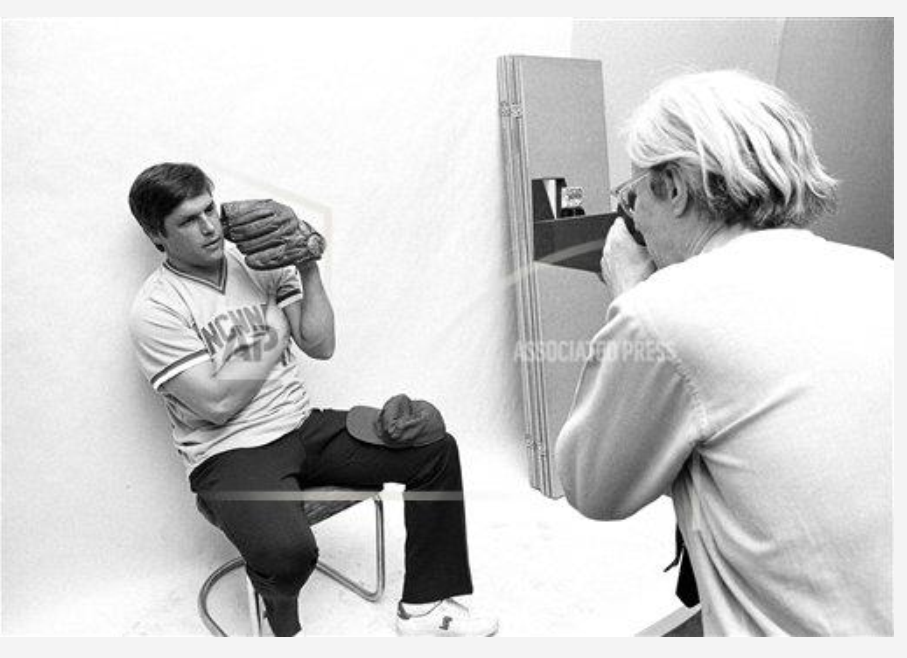
For the reference photos Andy Warhol used a Polaroid Big Shot camera, which we see in this second Rene Perez photo. To read more about the camera check out Camerapedia.

Warhol found the camera favorable for a couple of reasons, first and foremost he liked the pictures it took, secondly I believe the artist liked the intimacy it created between him and his subject. To take a good picture Polaroid cameras require the photographer to be in close proximity of the subject. This closeness is important to an artist who may only spend an hour with his subject.

Finally Polaroids provided one other asset in the pre-digital 1970s...


AP Images / Rene Perez

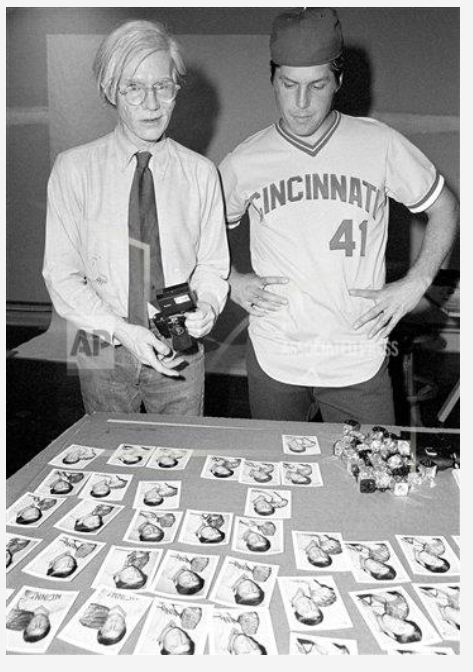
Instant feedback.

This way Andy Warhol could find out which pictures Seaver liked and which he did not. Typically a few of these Polaroids would be blown up to a large size and Andy would choose one to create the stencil for the final silkscreen.

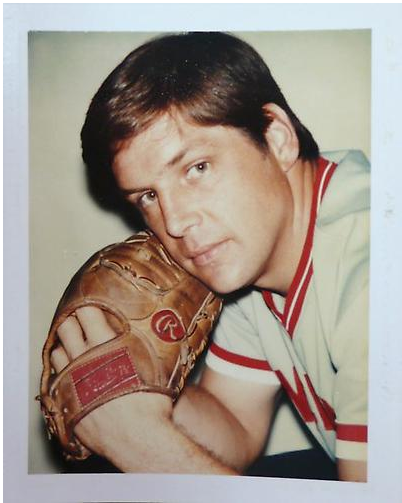
The Polaroid ultimately chosen is below: 


To see the Warhol-Seaver Polaroids we have found click here.

Carlos Rene Perez
The black and white photos in this post were taken by Rene Perez who was working as a stringer at the time. He is still active and has some fine art photography I found interesting especially his Edward Hopper inspired pictures, his website can be found here.

The Warhol Portrait Process
For as ubiquitous as Andy Warhol was with celebrities during the 1970s pictures documenting him at work seem pretty rare on line. We are very lucky to have the Rene Perez which happen to feature a Hall of Fame pitcher. The only other pictures I found in Getty Images were of Warhol's session with pop artist Pia Zadora.

There is also a 20/20 segment on YouTube that features Andy photographing model Farah Fawcett

Sources and Links
Andy Warhol Tom Seaver Index
Andy Warhol Index
The Warhol Diaries
Rene Perez
AP Images
Danziger Gallery
Getty Images / Life Magazine
youtube (20/20)
 

a thousand words

a thousand words
2008 World Champions